
PETG-CF 3D PRINTING
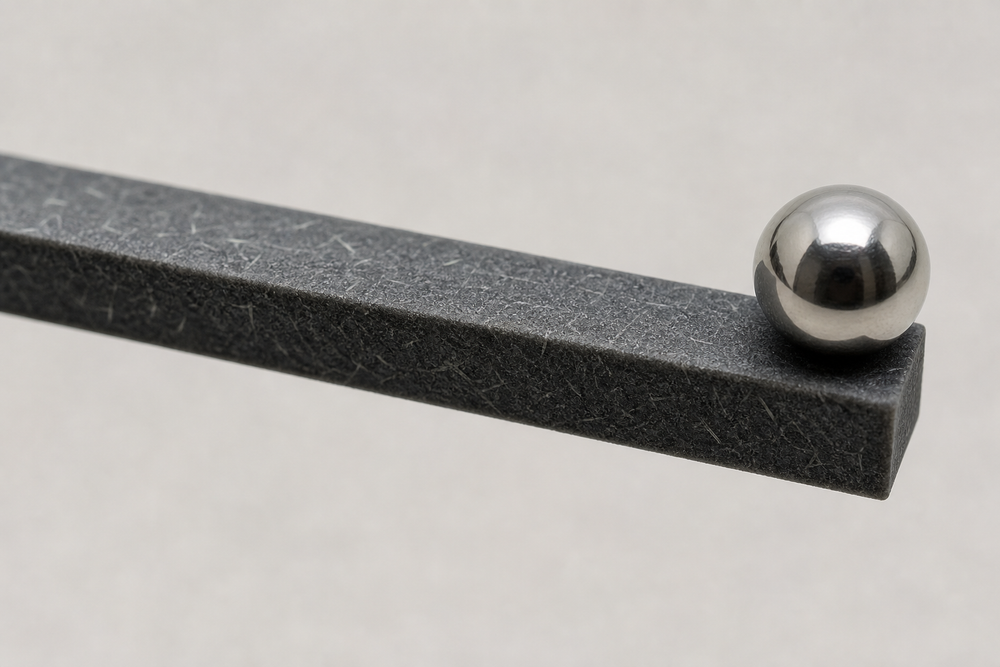
PETG-CF takes PETG's chemical resistance and easy printing and adds chopped carbon fibre for a sharp jump in stiffness. It holds its shape better than standard PETG under load and warps less, at the cost of a matte, slightly fibrous surface and reduced elongation — CF-filled parts are stiffer but more brittle than their unfilled equivalent. Bicester3D prints PETG-CF on hardened nozzles as a routine material, not a special order. Carbon-fibre materials carry a £25 minimum order — upload an STL or STEP for an instant quote.
WHEN PETG-CF IS THE RIGHT MATERIAL
- Jigs, fixtures and brackets that need to stay flat and stiff under load without warping.
- Lightweight structural parts — drone frames, mounts — where stiffness-to-weight matters more than surface finish.
- Parts that also need PETG's mild chemical resistance, just stiffer.
WHEN PETG-CF IS THE WRONG MATERIAL
- Anything needing high impact toughness or flex — carbon fibre makes PETG more brittle, not less.
- Cosmetic or show parts — the fibre finish is functional, not glossy.
- Sustained heat near an engine or heat source — step up to ASA-CF or PPS-CF.
TECHNICAL DATA
| Property | Value | Notes |
|---|---|---|
| Tensile strength | ~30–35 MPa | Lower than unfilled PETG (~45 MPa) — fibre adds stiffness, not ultimate strength |
| Elongation at break | ~10% | Far more brittle than unfilled PETG, which exceeds 300% |
| Heat deflection temp | ~65–70°C | Similar to unfilled PETG — CF doesn't add heat resistance here |
| Flexural modulus | ~1,600–1,700 MPa | The real benefit: parts stay flatter and stiffer under load |
| Nozzle wear | Abrasive | Hardened nozzle required — factored into quote |
| Chemical resistance | Good | Similar to unfilled PETG |
PRICING
Carbon-fibre composites carry a £25 minimum order — hardened-nozzle setup and premium material cost apply even on small parts. PETG-CF is the most cost-effective of our CF range. Quotes valid for 30 days.
GET YOUR PETG-CF QUOTE
Upload your STL, STEP, or mesh file to the quote tool. Price returns in seconds. Card, invoice (trade accounts) and bank-transfer payment accepted. Most PETG-CF orders are dispatched within 2 working days.
PETG-CF FAQ
Chopped carbon fibre raises stiffness and dimensional stability — parts stay flatter under load and warp less during printing. It does not make the base polymer dramatically stronger in tension, and it always reduces elongation, so CF parts are stiffer but more brittle than their unfilled equivalent. The surface comes out matte and slightly fibrous rather than glossy. Specify CF when rigidity, flatness or stiffness-to-weight is the requirement, not as a blanket upgrade.
Work up the ladder and stop at the first material that meets the spec. PETG-CF: stiff jigs, fixtures and brackets indoors — the cost-effective default. ASA-CF: the same stiffness but UV-stable, for parts that live outdoors. PPA-CF: near-metal stiffness and strength with heat tolerance well beyond either — load-bearing parts that run hot. PPS-CF: the top rung — continuous service near 200°C plus chemical, fuel and flame resistance. Each step up adds cost and lead time, so don't specify PPS-CF where PETG-CF already does the job. If in doubt, tell us what the part does and we'll recommend the cheapest material that meets it.
Matte and slightly fibrous — the fibre shows in the surface texture. It reads as functional and engineering-grade rather than glossy, and many customers prefer it on visible brackets and fixtures. But it is not a cosmetic showroom finish and it doesn't polish up the way ABS or SLA resin does. For display-quality surfaces, use SLA grey resin and reserve CF for the parts doing the work.
CF-filled filaments are abrasive, so they run on hardened nozzles, and the materials themselves cost several times more per kilogram than commodity filaments. Several also need drying and higher-temperature hardware before a job can start. That setup overhead is real even on a small part, so composite materials carry a £25 minimum order. Above that, pricing scales with size and quantity exactly like our standard materials.