
TPU 3D PRINTING
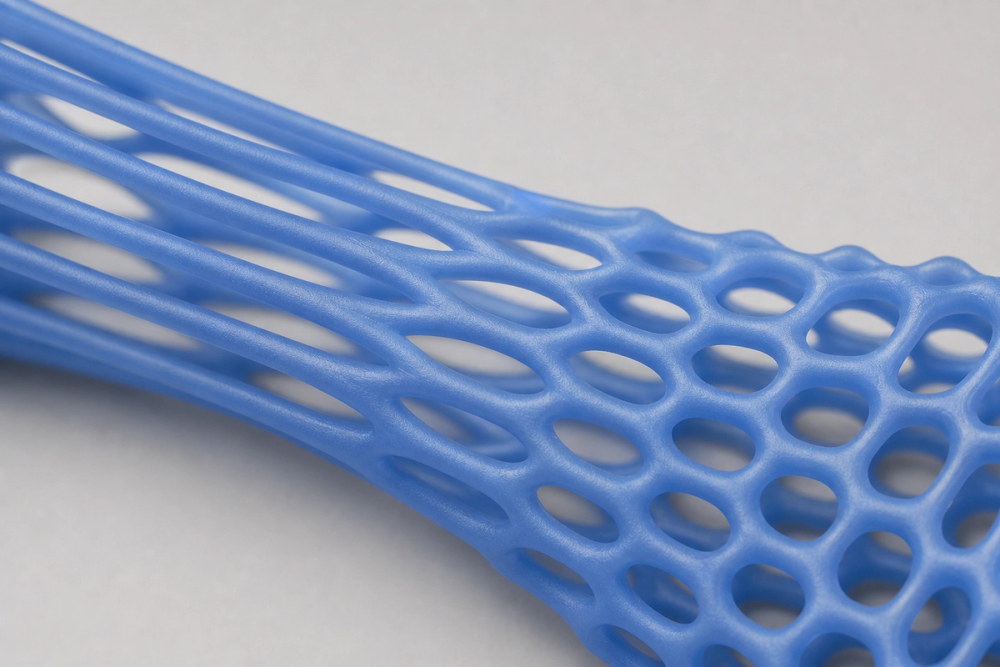
TPU — thermoplastic polyurethane — is the flexible material in the FDM catalogue. It bends, stretches, compresses and recovers, making it the only choice for soft-touch parts: gaskets, grips, vibration dampers, protective cases, custom seals. Bicester3D prints TPU at 95A Shore hardness as standard, with softer or harder grades available on request. Print speed is slower than rigid materials and bridging is limited — the workshop will help orient your part for the best result.
WHEN TPU IS THE RIGHT MATERIAL
- Gaskets and seals — custom-shape weather seals, equipment seals, fluid seals (non-food).
- Vibration dampers — motor mounts, drone landing gear, sensor housings, equipment feet.
- Protective bumpers and grips — phone cases, edge protection, soft-touch tool handles.
WHEN TPU IS THE WRONG MATERIAL
- Anything rigid — use PLA, PETG, ABS or polycarbonate.
- Tight dimensional tolerance — TPU is more forgiving but less precise than rigid filaments.
- Food contact — standard FDM food-safety caveats apply (layer-line bacteria risk).
TYPICAL TPU JOBS
TPU is the only flexible material in the FDM catalogue. The four jobs below cover most of what runs through the workshop — if you need flex, you almost certainly need TPU.
Pick the right material for your part
TPU is the only flexible filament we run — the right call for rubber-like parts. Browse the alternatives by use-case if you need rigidity, outdoor durability or fine detail.
TECHNICAL DATA
| Property | Value | Notes |
|---|---|---|
| Shore hardness | 95A (standard) | Softer or harder grades on request |
| Tensile strength | 40 MPa | Strong but stretches before breaking |
| Elongation at break | 500–700% | Highly elastic |
| Heat deflection temp | 60–80°C | Avoid hot environments |
| Print temperature | 220–240°C | Slow print speeds required |
| Bed temperature | 50–60°C | Forgiving bed adhesion |
| Abrasion resistance | Excellent | Outperforms most rigid plastics |
| Chemical resistance | Good to oils and greases | Limited resistance to strong solvents |
| Bridging capability | Limited | Design with vertical orientation in mind |
WHAT WE PRINT IN TPU
Representative TPU work from the workshop queue:
- Bespoke gaskets for vintage equipment — a discontinued pump seal reverse-engineered from the original rubber and reprinted in TPU, restoring a piece of workshop machinery to service.
- Drone arm bumpers and prop guards for a Buckinghamshire FPV team — replacing brittle PLA bumpers that snapped on first impact.
- Tool-handle overmoulds — soft-touch grips printed onto rigid PLA/PETG cores for ergonomic prototypes.
- Phone case prototypes for a consumer-product designer — drop-tested at multiple wall thicknesses to dial in the impact behaviour before tooling.
- Vibration-isolation feet for a workshop CNC — replacing OEM rubber feet that had compressed and gone hard with age.
PRICING
Per-part pricing from £10. TPU runs slower than rigid materials so price scales more with print time. No minimum order, no setup fees.
GET YOUR TPU QUOTE
Upload your STL, STEP, or mesh file to the quote tool. Price returns in seconds. Card, invoice (trade accounts) and bank-transfer payment accepted. Most TPU orders are dispatched within 2 working days.
TPU FAQ
Our standard TPU is Shore A 95 — semi-rigid, comparable to a roller-skate wheel or a hard rubber gasket. It bends easily, compresses under load, and recovers its shape, but it's not as soft as silicone or shoe-sole rubber. Shore A 85 (softer, more flexible) is available on request — let us know when ordering.
Not really — TPU is by definition a flexible elastomer. If you need a rigid part with a slight give, look at PETG (which flexes ~120% before breaking) or one of the impact-modified ABS variants. If you need pure rigidity, use PLA or polycarbonate.
Flexible filament is extruded at 15–30 mm/s versus 60–100 mm/s for rigid materials. Pushing flexible filament through a hot end too fast causes it to buckle inside the extruder and skip steps. The slow speed is what makes TPU prints reliable, and it's the dominant driver of TPU pricing.
TPU's continuous working range is roughly −20 to 80°C. Above 80°C it softens and loses elasticity; below −20°C it becomes glassy and brittle. For higher-temp flexible applications, silicone moulding is a better manufacturing route.
No. No FDM print is food-safe once printed — layer lines harbour bacteria and the print process is not sanitised. For food-contact gaskets, use medical-grade silicone moulding instead.