
FDM vs SLA for engineering parts: a decision guide
How to choose between FDM and SLA resin printing for functional parts: materials, detail, cost and size compared, with a plain decision table and a worked example.
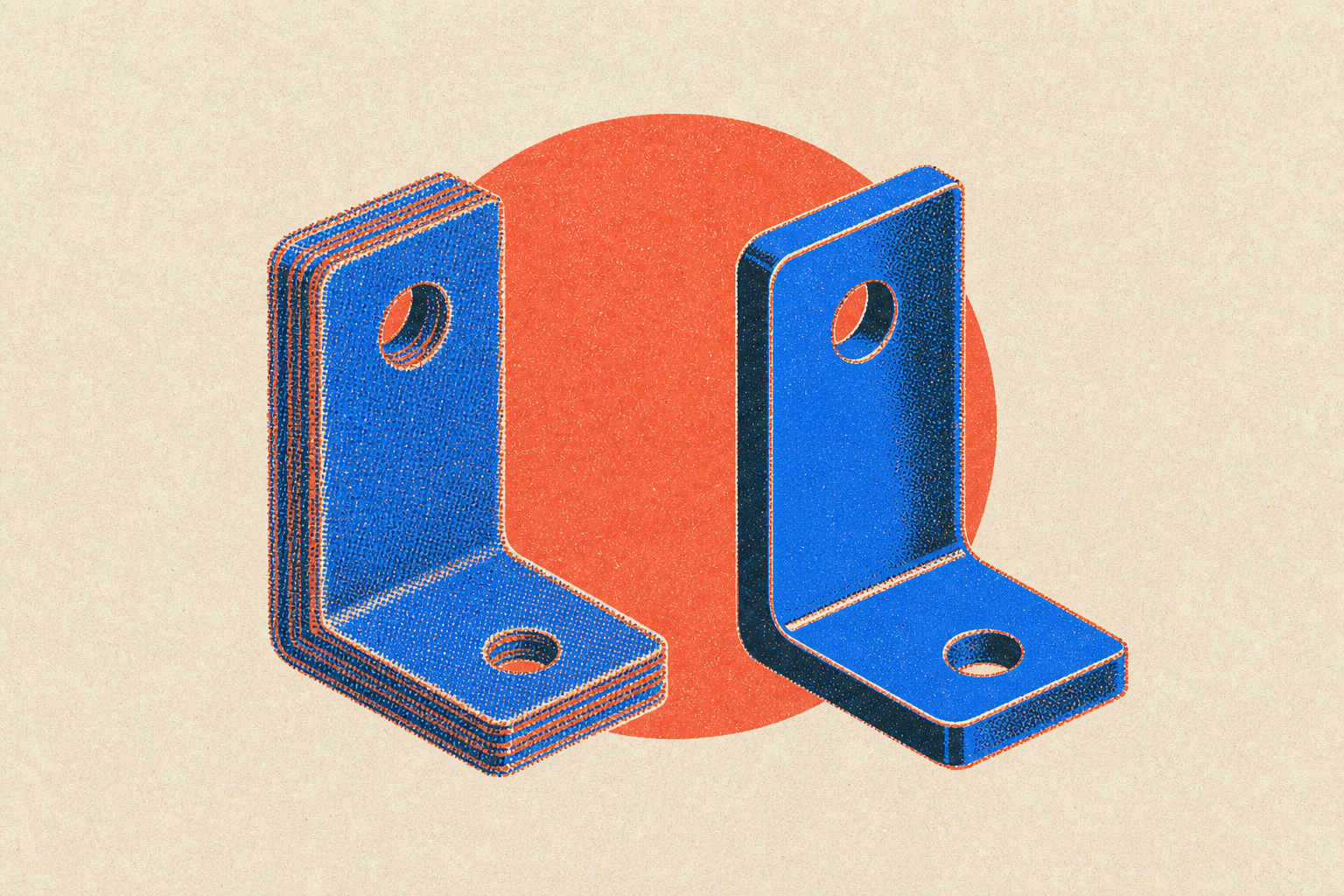
Most of the engineering parts we quote could be made on either of our two processes. FDM builds parts from engineering thermoplastics; SLA builds them from light-cured resin. Both produce accurate, functional components — but they behave differently under load, cost differently, and suit different jobs. Pick the wrong one and you usually pay more for a part that performs worse.
The short version: FDM for anything structural, load-bearing or outdoor, and for batches where cost per part matters. SLA for fine detail, smooth surfaces, and the specialist resins — clear, high-temperature, true silicone — that filament can't match. The rest of this guide is how we make that call, and where the honest limits sit.
What actually differs between the two processes
FDM (fused deposition modelling) melts a thermoplastic filament and lays it down in layers. It's the workhorse behind most of our FDM 3D printing work: the part you get is made from the same polymer families used in injection-moulded products — PETG, ASA, polycarbonate — with the strengths and quirks of an extruded layer structure. That means visible layer lines, and strength that depends on the direction of the load.
SLA (stereolithography) cures liquid resin with light, one thin layer at a time. Our SLA resin printing runs on a Formlabs Form 4, with layers typically between 25 and 100 microns — fine enough that surfaces come out smooth and small features stay crisp. Resin parts are close to isotropic, so strength barely varies with direction, but most standard resins are more brittle than engineering thermoplastics. That single trade — detail and finish versus toughness — drives most of the decision.
Where FDM wins
Materials are the big one. If the part carries load, gets dropped, clips onto something or lives outdoors, a thermoplastic will usually outperform a resin. PETG is our default for functional parts: tough, slightly flexible, inexpensive. ASA adds UV stability for exterior use, and polycarbonate and the carbon-fibre-filled grades cover stiffer, hotter jobs. These are real engineering plastics with decades of published data behind them, not imitations of one.
Cost and size follow. FDM machine time is cheaper, so for batches of ten to a few hundred parts it is almost always the economic choice. Build volume is larger too — over 300 mm in each axis, against roughly 200 mm on the longest edge for resin — so brackets, enclosures and jigs that would need splitting on a resin printer come off the bed in one piece.
Precision is better than most buyers expect. Surface finish shows layers, but positional accuracy on features like hole centres is excellent. The OpenSCAD DAC bracket we printed needed hole spacing you couldn't reliably hit with a hand drill, and FDM held it without fuss. What FDM can't do is very fine embossed text or features much below half a millimetre — the width of the extruded line sets a hard floor.
Where SLA wins
Detail and finish. At 25–50 micron layers an SLA part looks and feels closer to a moulded component: crisp lettering, small threads that engage properly, thin walls without gaps. If the part will be handled, photographed or shown to a customer — master patterns, visual models, front-facing enclosure parts — resin is usually the right call.
The resin library is the other reason. Because we print any resin compatible with the Form 4, the options go well beyond standard grey: High Temp for short-run tooling and parts that see heat spikes, clear resins for light pipes, lenses and fluid channels, and Silicone 40A — a true silicone, not a rubber-like imitation — for seals, gaskets and soft-touch parts that no filament can replicate.
Resin parts come washed, cured and with supports removed. Small nib marks where supports met the surface are normal, and we don't offer sanding or painting — so if one face is cosmetic, say so and we'll orient the supports onto the other side.
| Property | Value | Notes |
|---|---|---|
| Brackets, clips, load-bearing parts | FDM | PETG or ASA; polycarbonate where stiffness or heat is higher |
| Outdoor or UV exposure | FDM | ASA is UV-stable; most resins chalk and embrittle outdoors |
| Fine text, small threads, features under ~0.5 mm | SLA | 25–50 µm layers hold detail FDM physically can't |
| Smooth, near-moulded surface finish | SLA | No visible layer stepping on most geometry |
| Batches of 10–500 parts | FDM | Lower machine-time cost per part; bigger beds help nesting |
| Clear or translucent parts | SLA | Clear resin suits light pipes, windows and fluidics |
| Flexible parts | Either | TPU on FDM for durable flex; Silicone 40A on SLA for true silicone |
| Parts larger than ~200 mm | FDM | Exceeds the resin build area; prints in one piece |
A representative example
Take a flow-sensor assembly: a 45 mm threaded cap with embossed graduation marks, and the wall bracket that holds the unit outdoors. The cap wants SLA — the M30 thread prints cleanly and the markings stay legible at that scale. The bracket wants FDM in ASA — it's load-bearing and UV-exposed, and toughness matters more than finish. As representative figures, the cap lands around £15–20 in grey resin and the bracket £10–15 in ASA, both inside our normal dispatch times. (Representative, not a real job — exact pricing always comes from the model.)
What we can and can't do
FDM parts are weaker across the layers than along them. We orient parts so the load runs the strong way, but that only works if we know the load direction — mention it when you order and we'll handle the rest.
Standard grey resin is superb for visual and dimensional work and poor for snap fits, impact or repeated flexing. Tougher engineering resins in the Form 4 library close some of that gap, but if the part's job is to survive abuse, we'll usually steer you back to a thermoplastic.
Two practical notes. Resin parts top out at roughly 200 mm on the longest edge, and large resin parts get expensive quickly. And our online quote tool prices FDM instantly, while resin work goes through a short enquiry — resin choice and support orientation need a human look before we commit to a number. We usually come back the same working day.
As with all our work: no food-contact or medical certification on either process, and printed parts aren't a substitute for certified safety-critical components.
If you have an STL or STEP file, the fastest route is to price it now. Upload it for an instant FDM quote, or send it through the SLA enquiry with a line about the application and we'll recommend the right resin. Most FDM orders dispatch within 24 hours.
Get an instant quoteGot a project to print?
Upload your STL, STEP or mesh file. Get an instant price and same-week turnaround on most parts.