
FDM 3D PRINTING
FDM is the most widely used 3D printing technology — fast, affordable, and the widest material range of any process. Pick the polymer that matches your part's environment, get a price in seconds — most orders dispatched within 24 hours.
LIVE SPEC
±0.2 MM
0.1–0.3 MM
340 × 320 × 340 MM
6+ POLYMERS
MOST IN 24 HRS
£5/PART
APPLICATIONS




PICK YOUR POLYMER
The everyday workhorse. Easy, clean, fine detail. Indoor only — softens at 55°C.
Tough and chemical-resistant. The right call when a part has to work, not just look right.
Heat-resistant, sandable, acetone-smoothable. Engineering finish on demand.
ABS-strong with permanent UV resistance. The default for outdoor parts.
Flexible, abrasion-resistant elastomer. Bends, stretches, recovers.
Maximum stiffness, impact resistance and heat tolerance. The toughest in the catalogue.
HOW FDM PRINTING WORKS
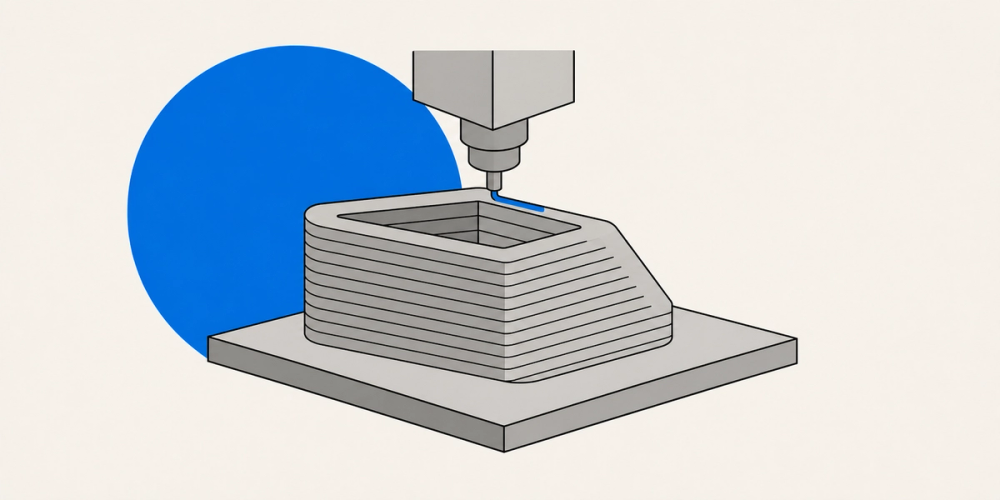
FDM (Fused Deposition Modelling) feeds a thermoplastic filament through a heated nozzle, which deposits material layer by layer to build up the part. Layer height typically 0.1–0.3mm — thicker for speed, thinner for finish.
FDM's strength is its material range. Switching from PLA to PETG to ABS to TPU is a filament change — not a different machine. That makes FDM the right choice when matching the polymer to the part's environment matters more than absolute surface finish.
We run multi-material FDM with verified ±0.2mm tolerance, 340 × 320 × 340mm build volume, and a workshop you can call mid-print. Quotes return in seconds from your STL or STEP.
TOLERANCE ±0.2 MM
LAYER HEIGHT 0.1–0.3 MM
BUILD VOLUME 340 × 320 × 340 MM
MATERIALS PLA, PETG, ABS, ASA, TPU, PC
COLOURS 30+ STANDARD
TURNAROUND MOST ORDERS IN 24 HRS
FDM MATERIAL COMPARISON
| MATERIAL | STRENGTH | HEAT | UV | BEST FOR |
|---|---|---|---|---|
| PLA | Rigid, brittle | 55°C | Poor | Visual prototypes, indoor |
| PETG | Tough, flexes | 70–80°C | Moderate | Functional, outdoor-OK |
| ABS | Tough, sandable | 95–105°C | Poor | Engineering, automotive interior |
| ASA | ABS-equivalent | 95–100°C | Excellent | Outdoor, automotive exterior |
| TPU | Flexible elastomer | 60–80°C | Moderate | Gaskets, grips, dampers |
| POLYCARBONATE | Maximum stiffness | 110–130°C | Moderate | Structural, impact, high-temp |
GET YOUR FDM QUOTE
Upload your STL or STEP for an instant price. From £5 per part. Most orders dispatched within 24 hours — no minimum order, no setup fees.
FDM 3D PRINTING FAQ
FDM (Fused Deposition Modelling) builds parts by extruding melted plastic filament one layer at a time. It's the most common and most cost-effective 3D printing technology, ideal for functional prototypes, brackets, jigs, enclosures and parts that need to take real load. Bicester3D runs production FDM printers in PLA, PETG, ABS, ASA, TPU and polycarbonate, with 0.2mm tolerance and build volumes up to 340×320×340mm.
FDM for functional parts: brackets, enclosures, fixtures, anything that needs to take load. Wider material range, larger build volume, lower cost per part. SLA when surface finish has to look injection-moulded or fine detail matters: miniatures, jewellery casting, presentation prototypes, fine-feature parts. Most engineering projects start FDM and only move to SLA if surface finish becomes critical.
Single-piece up to 340×320×340mm — the build volume of our production FDM printers. For larger parts we split the model into bondable sections (we can advise on cut lines), then assemble after printing. Most engineering parts and prototypes fit comfortably inside the single-piece envelope.
Standard FDM tolerance is ±0.2mm for PLA, PETG and TPU; ±0.3mm for ABS and ASA. For tighter tolerances, SLA on our Formlabs Form 4 holds ±0.15% (min ±0.05mm) on small parts. Real-world tolerance varies with part geometry, orientation and material shrinkage — if your design is tolerance-critical, send us the drawing and we'll advise on the most accurate process.
FDM prints start from £5 per part (small PLA), with most prototype-sized parts in the £10–£50 range. Cost scales primarily with material volume (cubic centimetres of plastic), then layer height (finer = slower = more expensive), then quantity (volume discounts kick in from 10+ identical parts). Upload your STL or STEP for an instant volume-accurate quote in seconds — no signup required.